Cuba is not alone - report from the 2026 May Day Brigade
Campaign News | Monday, 1 June 2026
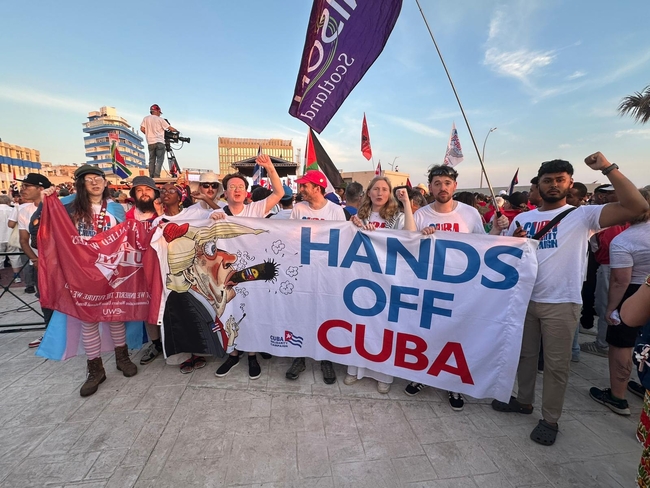
Brigadistas at the Anti-Imperialist Platform in Havana on May Day
CSC’s 19th annual Young Trade Unionists’ May Day Brigade took place at an acutely difficult moment for Cuba. Trump’s oil siege had created severe shortages across the island, creating significant obstacles for the Cuban Institute of Friendship with the Peoples (ICAP) to organise the visit, while in addition a number of airlines had cancelled routes to Cuba.
Yet with US aggression at its most extreme since the early 1960s, the brigade could not have arrived at a more important time. Ten young trade unionists from Britain, including official representatives from CWU and PCS, alongside members of UNISON, Unite and UCU, travelled to Cuba to learn more about its Revolution and the increasingly urgent task of defending it.
Through a programme of political discussions, workplace visits, agricultural work and May Day celebrations, the delegation witnessed both the immense challenges facing Cuba and the resilience of its people. Alongside more than 200 delegates from across the world, the brigade demonstrated that Cuba is not alone.
Facing down US aggression
Difficulties at the Julio Antonio Mella Camp, where generations of solidarity brigades have stayed, meant that our delegates were instead accommodated at the Copacabana Hotel in Miramar, Havana. The location carried its own significance: in 1997, it was the site of a terrorist attack organised by Cuban exile and CIA agent Luis Posada Carriles, which killed Italian tourist Fabio di Celmo. It provided a stark reminder of the violence Cuba has faced since 1959.
At the Memorial de la Denuncia museum, delegates learnt more about the counter-revolutionary attacks carried out against Cuba following the triumph of the Revolution, which have resulted in the deaths of nearly 3,500 Cubans, as well as the decades-long efforts by the US government to undermine and overthrow the revolutionary project.
The first seminar of the visit, held at Casa de la Amistad (Friendship House), explored the legacy of Fidel Castro, with contributions from Sissi Abay Díaz, Deputy Director of the Fidel Castro Centre, as well as the Palestinian ambassador to Cuba, Dr Akram Mohammad Rashid Samhan, and two young Palestinians studying medicine at ELAM (the Latin American School of Medicine).
Sissi thanked the brigade for coming at such a difficult time, saying that its presence reflected Fidel’s belief that “human beings need to feel there is hope for a better world.” The Palestinian ambassador highlighted the shared struggles of Cuba and Palestine, saying that “to talk about Palestine, to advocate for Palestine, is to talk about and advocate for Cuba too.”
Further seminars examined Cuba’s transition towards renewable energy and the enduring importance of Cuban national hero José Martí, whose ideas continue to shape the country’s political identity and its commitment to sovereignty.
The human cost of the blockade
The impact of the blockade was especially clear when the brigade watched a special screening of the new documentary by Belly of the Beast: From Cuba to Calabria: Medical Missions in Times of Crisis. The film highlighted the internationalism of Cuba’s medical brigades working in one of Italy’s poorest regions at a time when these missions are being targeted by US pressure.
During a discussion after the screening, Liz Oliva Fernández from Belly of the Beast described the devastating human consequences of intensified sanctions. She pointed to the rise in Cuba’s infant mortality rate, which increased from just over four deaths per 1,000 live births in 2018 to almost ten in 2025, explaining that “we could have prevented the deaths of 1,800 babies.”
The reality behind those figures became even clearer during the brigade’s three-day visit to Matanzas. At a maternity home in Cárdenas, doctors and nurses explained the vital role their facility plays in Cuba’s public healthcare system, supporting expectant mothers considered high-risk or experiencing complications late in pregnancy.
Despite Cuba’s long-established approach to sex education, staff described a sharp rise in teenage and unwanted pregnancies due to shortages of contraception. They also reported increasing numbers of women giving birth at home without medical assistance because ambulances were unable to reach them due to fuel shortages. Alongside this, medical workers are facing severe shortages of medicines and basic supplies, including folic acid.
The brigade donated medical aid and committed to building on the success of the Cuba Vive Medical Aid Appeal upon returning to Britain.
Under pressure, but still advancing
The trip to Matanzas also revealed the wider impact of the oil siege. In Varadero, delegates stayed beside one of the world’s most famous beaches, with crystal-clear waters and white sand. Yet the tourist resorts that would normally attract visitors from across the globe were largely deserted – another visible sign of the pressure facing Cuba.
Despite these hardships, the brigade also saw the achievements of the Revolution. At Ciudad Escolar Libertad, delegates heard how the former military barracks of the Batista dictatorship had been transformed into an educational complex in September 1959. The site now contains primary, secondary, vocational and special education facilities, alongside the Enrique José Varona University of Pedagogical Sciences.
At the Rubén Bravo Álvarez Primary School, delegates learnt how Cuba’s education system responded during the COVID-19 pandemic, ensuring children’s education continued despite the crisis. Later, while delivering a Braille machine to the Abel Santamaría School for blind and visually impaired children, UNISON member Ronan Ogilvy spoke on behalf of CSC and the British brigade. Recognising “the grave impact of the blockade on the education of children in Cuba,” he pledged that the delegation would return home committed to strengthening the solidarity movement.
The brigade volunteered at several agricultural cooperatives over the course of two weeks. While harvesting guava at a Credit and Services Cooperative in Cardenas, Gladys Guerra Mendoza, the regional president of the National Association of Small Farmers (ANAP), explained that private farmers own and work their land independently, while pooling resources to access credit and supplies. Major decisions are made through an assembly of the cooperative’s owners. She praised the farmers’ contribution to Cuba’s pursuit of food sovereignty – a goal our delegates hoped their own efforts would support.
On the eve of May Day, the brigade visited Navegación Caribe, a shipping company based in Havana, meeting workers from the National Union of Transport and Port Workers (SNTTP). When asked about the biggest issue facing members, union General Secretary Katia Labrada identified low salaries as the main concern. However, she stressed that the company had enormous potential to grow and improve workers’ pay were it not for the blockade.
The homeland is defended
As the delegation travelled along Havana’s Malecón seafront after the visit, tour guide Luís reflected on what they would witness on May Day. Pointing towards the José Martí Anti-Imperialist Platform, located in the shadow of the US Embassy, he said: “There we will show the empire our position.”
On 1 May Cuban workers did exactly that. Half a million marched through Havana as the sun rose over the Malecón, Cubans of all backgrounds united behind the banner la patria se defiende (the homeland is defended). Our brigade joined this defiant and joyful spectacle, carrying the flags of their unions.
The following day, hundreds of representatives of trade unions and solidarity organisations from around the world participated in the International Solidarity conference. Speaking on behalf of CSC, director Rob Miller praised the resilience of the Cuban people and called for action. “We each have our own trenches where we must fight in our own countries to campaign against the blockade and build the broadest possible movement in solidarity with Cuba and work across our societies to build real material help for the Cuban people.”
President Miguel Díaz-Canel thanked all present for standing with Cuba “because we know that to be here in Cuba and with Cuba in these times requires courage.” He concluded by describing international solidarity as “the most powerful weapon against global selfishness,” and declaring: “The heroism, resistance, creativity, dignity, and history of the Cuban people, together with you and your solidarity, will bring us victory!”
Brigadista testimony