Fidel Antonio Castro Smirnov addresses meeting of MPs
Campaign News | Wednesday, 28 January 2026
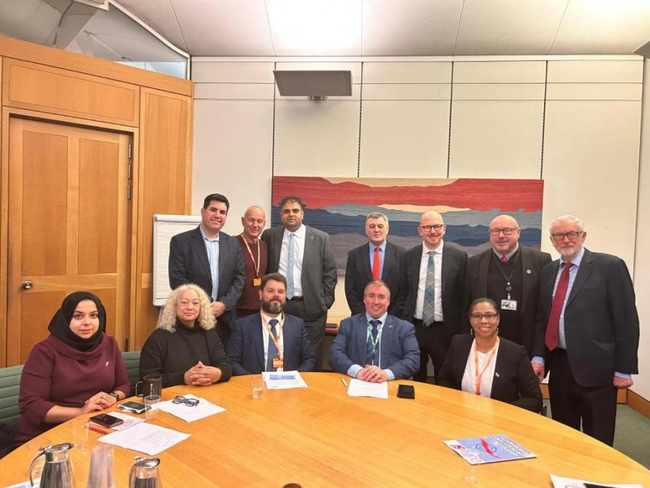
Members of the APPG on Cuba with Fidel Antonio Castro Smirnov
The All-Party Parliamentary Group (APPG) on Cuba and its newly-elected chair Steve Witherden MP welcomed Fidel Antonio Castro Smirnov, Cuban scientist and grandson of Fidel Castro, to Parliament on Tuesday 27 January as he embarked on a speaking tour to mark the centenary of his grandfather’s birth. Parliamentarians from acrss the house gathered to hear Fidel address the group on Cuban science, his grandfather’s legacy, the impact of the blockade and the current situation in Cuba.
Attending the meeting alongside Ambassador Ismara Vargas Walter and staff from the Cuban Embassy, Fidel Antonio spoke powerfully about the role of science in social development and how it was “one of the originalities of the Cuban Revolution.” Quoting his grandfather in 1960, when he proclaimed that “the future of our homeland must necessarily be a future of men of science”, Fidel Antonio said that “never before in an underdeveloped country had scientific thought and the practice of scientific research played such a leading role in a process of social transformation.”
Highlighting one of Fidel’s proudest feats, the establishment of the Latin American School of Medicine (ELAM), Fidel Antonio described the school as a "true symbol of cooperation in science and health." With more than 32,000 graduates from 122 countries since its founding in 1999, he quipped that ELAM goes a long way in fulfilling his grandfather’s ambition for Cuba’s doctors to win “the first Olympic medal for solidarity.”
Fidel Antonio asked the MPs to consider how the extraterritorial application of the blockade erodes Britain’s own sovereignty. “Does it make sense”, he asked, “for a British bank to reject a transfer of medical supplies destined for children in Havana, simply for fear of a fine?” Referring to the current assault on Cuba, as well as attacks on other nations by the Trump administration, he told guests that "Sovereignty is not negotiable; it is the very oxygen of a nation” and said that while “entropy is a natural state, building bridges is an act of human will.”
He concluded by expressing “deep gratitude for the actions of support and solidarity towards Cuba received from personalities, political organisations, solidarity movements, and social and popular movements in Britain.”
Jeremy Corbyn MP thanked Cuba’s medical workers for their continued humanitarianism and asked about the current energy situation in Cuba following the US attack on Venezuela. The ambassador noted the “extreme difficulty” of the current situation, with the country being unable to “talk about a long-term strategy.” Rather, she said, Cuba is being forced to assess the situation on a day-by-day basis. Fidel Antonio described recent the recent escalation as “economic terrorism in its highest form.”
Responding to Kim Johnson MP’s question about what the APPG on Cuba, and British Parliamentarians more broadly, can do in their work, Fidel Antonio emphasised the importance of “promoting exchange in areas of joint interest and experience”, particularly in science. The Ambassador highlighted that the ‘United Kingdom-Cuba Political Dialogue and Cooperation Agreement’ was still yet to be ratified, but such an agreement could provide a “strong framework for improved ties.”