Cuba Under Siege: Parliament hears urgent call to defend Cuba’s sovereignty and oppose economic warfare
Campaign News | Thursday, 12 March 2026
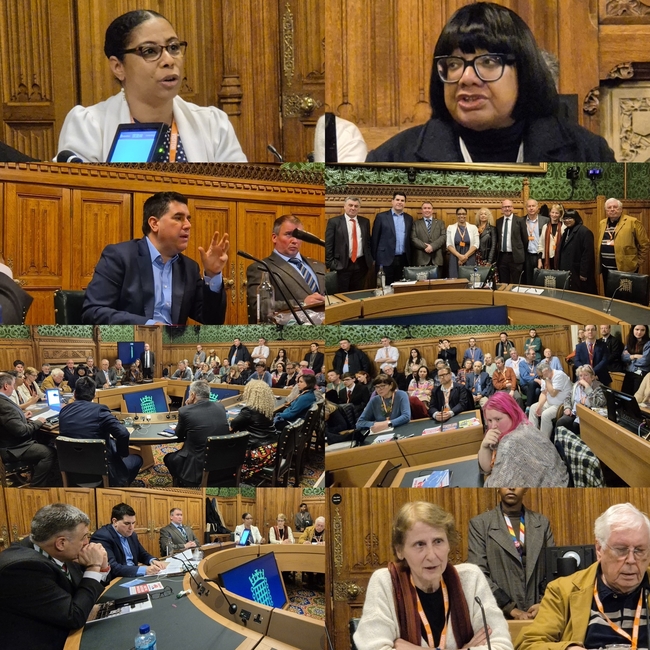
Clockwise from top left: Ambassador Ismara Vargas Walter; Diane Abbott MP; the panel with MPs; audience members; Dr Emily Morris and Bernard Regan; MPs Ian Byrne, Richard Burgon, Steve Witherden; the
A packed and urgent public meeting in Parliament on Wednesday 4 March heard MPs, the Cuban Ambassador, academic experts and campaigners warn that Cuba is facing one of the most dangerous moments in recent decades as escalating US sanctions tighten the pressure on the island’s energy system, healthcare services and food supplies.
Opening the meeting, Steve Witherden MP stressed both the humanitarian and political gravity of the crisis. He said there should be “common ground in Parliament on the principle that nations have the right to sovereignty and self-determination” and warned that “collective punishment of a civilian population raises profound humanitarian and legal concerns”.
He pointed to the growing support in Westminster for opposition to the US measures, highlighting Early Day Motion 2739, tabled in Parliament in response to the latest sanctions, which had already secured support from MPs across a number of parties. “There’s real consensus on this,” he said, while urging those MPs who had not yet signed to do so.
The Cuban Ambassador, Ismara Vargas Walter, told the meeting that the latest measures imposed by Donald Trump marked a qualitative escalation. “This is no longer embargo, as many have tried to defend. This is a siege. This is economic warfare,” she said.
Describing the immediate consequences, the Ambassador explained that blackouts had reached devastating levels. “Just two days ago, our national grid was forced into blackouts of up to 20 hours a day, paralysing two-thirds of our population,” she said. “As we speak right now, most of the country’s disconnected.”
She gave a stark account of the effects on Cuba’s health system, telling the audience: “Inside our hospitals, the persistence of power outages has caused surgical teams to perform complex procedures, even on newborn infants, relying entirely on the illumination of their cellphones. That is unexplainable in the 21st century.”
Ambassador Vargas Walter also praised the role of solidarity in Britain, saying that practical support organised through the Cuba Solidarity Campaign and the trade union movement “has been a lifeline”. Referring to the Cuba Vive appeal, she said: “Your solidarity, dear friends, actively saves Cuban lives.”
Diane Abbott MP placed the current crisis in a broader political context, describing Cuba as a longstanding symbol of resistance and independence. “The Cuban people have been heroes and heroines to progressives around the world for generations,” she said.
Warning of the seriousness of the current moment, Abbott said: “This is clearly a perilous time for Cuba and its people,” adding that the wider international climate under Trump was one of aggression and instability. She told the meeting that “it feels as if the dangers are as great for Cuba as the Cuban missile crisis or the Bay of Pigs invasion”.
Abbott argued that Cuba continued to be targeted precisely because of the alternative example it offers to the world. “Cuba has been through so much and its people have suffered so much, but it is partly because of the example it offers to the rest of the world,” she said. She called for solidarity to take “practical form”, including fundraising and material support.
Fresh from a recent visit to Cuba, Dr Emily Morris, development economist at UCL, gave a vivid account of conditions on the ground and of the extraordinary resilience of the Cuban people. Arriving just after Trump’s executive order, she said it quickly became clear that new oil deliveries were not coming, yet what struck her most was the calm determination with which Cubans faced the crisis.
“You cannot imagine, unless you’ve been there, how creative they are in working through them,” she said, describing how people continued to work, adapt and develop new projects despite fuel shortages, power cuts and severe financial obstacles.
At the same time, Morris underlined the human cost. “People are dying. They’re definitely dying. The most vulnerable people in Cuba are dying,” she said, explaining that shortages and transport problems were having deadly consequences for those most in need.
Morris also highlighted Cuba’s efforts to respond strategically to the crisis through renewable energy and social protection. She described “a level of cooperation which is remarkable”, with public institutions, workers and parts of the private sector all trying to keep essential services going. Addressing the question of travel, she said that people who continue to visit Cuba would find “a warmer welcome than ever”.
Richard Burgon MP described the tightening siege on Cuba as part of a wider and deeply dangerous US strategy towards Latin America and the wider world. He praised the growing parliamentary support for EDM 2739 and said it showed “the widespread support for the right of the Cuban people to determine their own fate”.
Burgon argued that the latest measures were not isolated acts, but part of a wider doctrine of domination. Referring to Trump’s strategy documents, he said they made clear that Washington aimed to reassert control over the region. “He wants to turn the entire region back into a colony where the USA controls everything – controls its land, its resources, its people,” Burgon said.
He reminded the meeting that the goal of US policy towards Cuba had long been explicit: “To bring about hunger, desperation, and overthrow of government.” What was happening now, he argued, was an intensification of a historic policy of collective punishment.
Burgon concluded by stressing the special place Cuba holds in the international solidarity movement because of its own record of internationalism. “There’s been no country on Earth that has shown more solidarity with oppressed peoples than Cuba,” he said, recalling Cuba’s role in southern Africa, its medical brigades and its support to countries facing disaster and crisis. “All decent people stand with Cuba,” he told the room.
Bernard Regan, National Secretary of the Cuba Solidarity Campaign, thanked the APPG and MPs from across parties who had backed the parliamentary motion, while urging supporters to keep building pressure. He argued that the British government could not claim to support sovereignty in one case while remaining passive in another. “What about the right to self-determination and sovereignty of the people of Cuba?” he asked.
Regan said the US claim that Cuba represented a threat was absurd. “If Cuba is a threat, it’s a threat by its good example,” he said, pointing to Cuba’s record of international solidarity, from southern Africa to medical missions across the world.
He emphasised the need to match words with action and highlighted the practical solidarity already organised through the Cuba Vive appeal which had sent eight consignements of medical and food aid to Cuba in the last 15 months.
Regan ended with a call to deepen campaigning and solidarity: “We need to amplify that and we need to multiply it,” he said. “We campaign actively to defend Cuba and fight for the right of Cuba to determine its own future.”
Closing the meeting, Steve Witherden MP returned to the urgency of the situation. “People are dying now as a result of what the US is doing,” he said, echoing Dr Morris’s warning from the floor. He also encouraged people not to be deterred from visiting Cuba, calling travel “one of the best ways in which we can show our support and our solidarity with the Cuban people”.
The meeting ended with a final appeal from Ambassador Vargas Walter, who thanked those present and urged them to continue turning solidarity into action. “Cuba deserves to be better and especially we deserve to continue having the power to determine our future,” she said. “So stay with us. Continue believing in Cuba.”
The strength of feeling in the packed committee room made clear that support for Cuba is growing – in Parliament, in the trade union movement and across the solidarity movement more broadly. But the message from every speaker was equally clear: the situation is urgent, the humanitarian consequences are severe, and practical action is needed now.
Take action now!
Supporters can help by:
signing and promoting the Urgent Call for Peace and Sovereignty
writing to their MP asking them to sign EDM 2739
donating to the Cuba Vive Food Aid Appeal
organising support through their trade union or local organisation,
and helping spread the truth about the impact of US sanctions on Cuba.
Cuba is not alone – but solidarity must be made real.