Bearing witness and building solidarity: inside the Nuestra América Convoy to Cuba
Campaign News | Tuesday, 21 April 2026
Natasha Hickman, CubaSí editor and CSC Campaigns and Communications Manager reports back from Havana.
In March, I travelled to Cuba with Jeremy Corbyn and Richard Burgon as part of the Nuestra América Convoy, joining more than 600 delegates from across the world delivering over 35 tonnes of humanitarian aid.
Organised by Progressive International, the convoy brought together activists, trade unionists, politicians and journalists from the United States, Latin America and Europe. The scale of that mobilisation – across continents, in a short space of time and under difficult logistics – was a significant achievement, matched on the ground by Cuban organisations, particularly ICAP (Cuba’s international friendship institute), who coordinated the programme under extremely challenging conditions.
For many participants – especially those travelling from the US – it was their first time in Cuba. Among them were young Cuban Americans seeking to reconnect with their heritage and understand the reality of life on the island beyond decades of hostile narratives.
For those of us travelling with CSC, the convoy was both a moment of renewed internationalism and a continuation of work sustained over many years. Jeremy and Richard are both long-standing supporters of CSC and past participants in our Cycle Cuba Challenge (page 24). Corbyn travelled the morning after speaking at a Cuba Vive fundraising event in his constituency (page 11), and Burgon shortly after addressing a CSC parliamentary meeting (page 7).
Between us we carried 70kg of Cuba Vive medical aid in suitcases, including specialist infusion pumps for Havana’s main cancer hospital, the Institute of Oncology and Radiobiology. There, the human impact of the crisis was immediate. During our visit, the power cut out briefly before the hospital’s generators kicked in. Staff explained that while backup systems can sustain operations for up to three days, those first moments are critical – particularly for patients reliant on life-saving equipment. In neonatal wards, they described having to manually pump oxygen to incubators when outages occur.
When we delivered the infusion pumps, Dr Luís Eduardo Martín Rodríguez, director of the hospital, said: “On behalf of all our patients and staff I want to thank CSC and all the unions who have come together to raise money to buy these resources. It is an incredibly humane, altruistic, and vital gesture for Cuban healthcare, especially oncology. It has both significant material value and human value – helping us minimise the effects of the blockade and continue treatment for our patients.” When asked what was most needed, his answer was simple: “Everything.”
The aid we delivered formed part of a much wider effort. Delegations brought supplies directly to hospitals, polyclinics and community centres across the country, before gathering on 21 March at Havana’s Friendship House, where aid was handed over for distribution. On the same day, solidarity groups worldwide organised coordinated actions to raise awareness of the blockade (see page 22).
What distinguished the convoy was not only the scale of the aid, but the scale of attention it generated. Journalists – particularly from the United States – who had never previously covered Cuba travelled with the delegation. Influential US commentators including Hasan Piker (who has 3 million followers on Twitch, and 1.86 million subscribers on YouTube) and Katie Halper produced content reaching millions online. In Britain, coverage by journalists Steven Methven (Novara Media) and Owen Jones who took part in the Convoy, brought the reality of the blockade to far wider audiences, including many not previously engaged in solidarity work.
The convoy also generated significant mainstream media coverage, with major international wire services reporting on its activities. Alongside this, independent journalists and content creators helped challenge what many participants described as an “information blockade” around Cuba.
This mattered. The convoy’s stated aim was not only to deliver aid, but to shift the narrative – to reframe Cuba’s current crisis not simply as a humanitarian emergency, but as a political one shaped by US policy.
Those new to reporting on Cuba also got to experience the misinformation and negative propaganda from the US. During the visit, the United States Embassy in Cuba issued a warning to US travellers about potential “anti-US demonstrations” linked to the convoy. In reality, one of the largest delegations present was made up of US citizens participating in solidarity activities. The warning reflected a long-standing pattern: hostility from the US government towards Cuba is routinely presented as hostility from the Cuban people towards US citizens – something clearly contradicted by the warm reception given to the hundreds of US delegates on the ground.
The presence of Irish band Kneecap also drew attention, but some coverage misrepresented their role. Right wing commentators accused their performance of causing a national power cut which killed people on ventilators. In reality they performed an eight minute set of three songs as part of a pre-organised community event at the Pabellón Cuba – a family day with stalls, music and activities – rather than the kind of headline concert reported elsewhere.
I arranged for two of the Cuban Five, René González, Gerardo Hernández and their families to meet with Richard, Jeremy and Mo Chara from Kneecap. When asked what we could do on our return, Gerardo urged us to act as witnesses: “Spread your experience, spread the truth that you witness here. Because the US is all the time spreading lies about Cuba, but at the same time doesn’t let its citizens come here and see for themselves.”
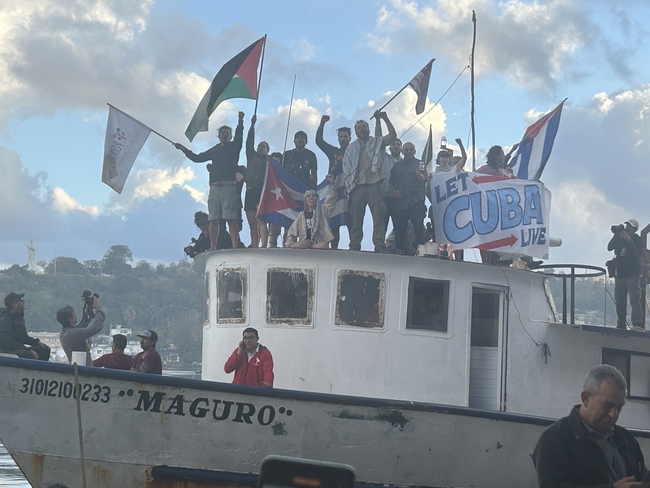
After the main delegation departed, I stayed on for further meetings – and witnessed the arrival of the convoy’s flotilla into Havana. Delayed by technical issues and difficult weather conditions, the boats arrived a few days later than planned. Among those onboard the first boat to arrive (renamed ‘Granma 2.0’) was Brazilian activist Thiago Ávila. Thiago was a participant and organizer of the Global Sumud Flotilla to Gaza, as well as having taken part in a solidarity brigade to Cuba in 2023. “The flotilla shows that the people of the world will never leave Cuba alone… and that we do not fear US imperialism,” he said.
By that point, the city felt markedly quieter. With the departure of hundreds of delegates – particularly the large US contingent – the contrast was immediate. But the deeper change was the absence of tourists. Across Havana, the impact was stark: hotels partially closed, restaurants empty, and streets that would normally be full of visitors unusually subdued. In Old Havana, where tour buses once lined the streets, and queues formed outside landmarks like El Floridita and La Bodeguita del Medio, there was now space and silence. One night I ate alone in a pedestrianised street that, even a year ago – despite already reduced visitor numbers following Covid and US visa restrictions – had been busy and lively.
The decline in tourism is having a serious economic impact. The British government remains one of only four European governments to advise against all but essential travel to Cuba, a position that has reduced British visitors, despite the fact that travel to the island is desperately needed, easy and rewarding. Our government’s travel warning is excessive and does not reflect realities on the ground. Yes, things are incredibly tough for Cubans, but visitors are largely insulated – staying in accommodation with generators or solar power, and experiencing limited disruptions aside from less frequent and more expensive transport. At a time when tourism is a vital source of income, travel to Cuba remains one of the most direct ways to support the economy and the Cuban people (see page 24) – advising tourists not to panders to US government interests.
It was a privilege to take part in the convoy at such a critical moment. It demonstrated the scale of international solidarity, reached new audiences and reinforced that Cuba is not alone.
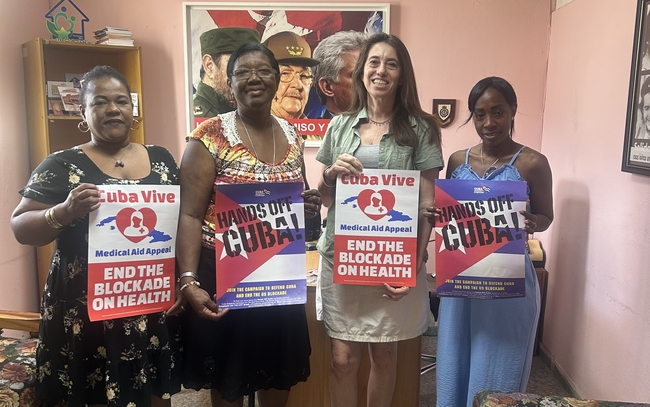
with members of the Cuban Health Workers Union (SNTS)
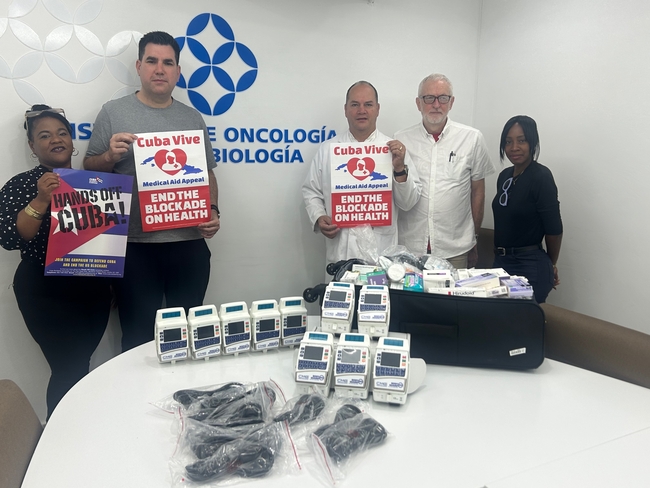
Delivering aid to the, Insitute of Oncology and Radiobiology
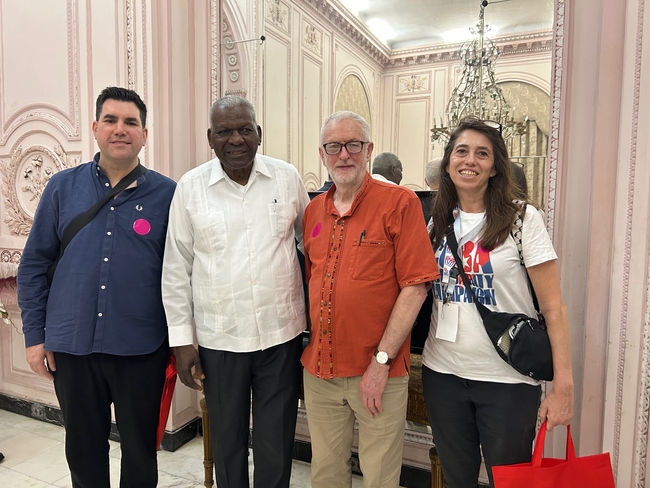
Esteban Lazo Hernández, President of the Cuban National Assembly, with Jeremy Corbyn, Richard Burgon and Natasha Hickman
British and Irish visitors with Miami Five members and families in Havana on 22 March 2026 left to right: Amber Hernandez, Rene Gonzalez, Olga Salanueva, Gemma Hernandez, Adriana Perez, Gerardo Hernan