Trump escalates economic warfare and threat of military intervention against Cuba
News from Cuba | Thursday, 7 May 2026
On 1 May, Donald Trump issued another Executive Order against Cuba, intensifying the US economic war on the island to unprecedented levels.
Citing Cuba’s unsubstantiated “threats to US national security and foreign policy”, the new coercive measures grant sweeping powers to freeze assets and sanction anyone – whether US or foreign citizens – who cooperates with Cuba’s energy, finance, mining or defence sectors.
Foreign banks risk being cut off from the US financial system if they fall foul of unilateral US Treasury sanctions. Individuals and even their families can be barred from entering the United States, while the measures also threaten those involved in humanitarian cooperation with Cuba. The sanctions list can be expanded at will by the State Department – effectively at the whim of Secretary of State Marco Rubio.
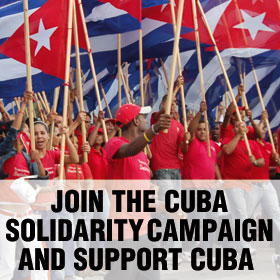
It was no coincidence that, on the same day millions of Cubans marched in May Day rallies across the country under the banner “The Homeland is Defended”, Washington announced this latest escalation.
The new measures come alongside increasingly aggressive rhetoric from Trump himself, including explicit threats of military intervention. Speaking at an event in Florida on 1 May, the US president claimed the United States would be “taking over” Cuba “almost immediately”.
“On the way back from Iran, we’ll have one of our big – maybe the USS Abraham Lincoln aircraft carrier – the biggest in the world – we’ll have that come in, stop about 100 yards offshore, and they’ll say, ‘Thank you very much. We give up,’” he told reporters.
On 5 May, Rubio visited the headquarters of the US Southern Command to meet General Francis L. Donovan to discuss what he described as “threats that undermine security, stability and democracy in our hemisphere”. He later posted a photograph of the meeting in front of a map of Cuba.
The Trump administration has been relentless in its attacks on Cuba this year. On 29 January, another Executive Order declared a so-called “national emergency” over the alleged “unusual and extraordinary threat” posed by Cuba and threatened sanctions against countries supplying oil to the island. The result has been a de facto oil blockade that has plunged Cuba into a deepening energy crisis.
Power cuts have closed schools and workplaces, crippled public transport, disrupted water supplies and forced the postponement of thousands of medical operations. Hospitals and essential services continue to operate under severe strain.
A recent report from the Center for Economic and Policy Research found that the expansion of US sanctions beginning under Trump’s first administration – maintained by Joe Biden and intensified again under Trump’s second term – is likely the primary cause of a dramatic rise in infant mortality in Cuba.
According to the report, infant mortality surged by 148 per cent between 2018 and 2025. Had mortality rates remained stable, an estimated 1,800 babies who died during that period would still be alive. The report links the increase directly to tightening US sanctions, shortages of medicines and medical supplies, and the wider economic devastation caused by Washington’s unilateral coercive measures.
Increased sanctions mean increased suffering: more shortages, more pressure on the economy, and more threats against any country, company or individual attempting to trade with or assist Cuba.
Cuban Foreign Minister Bruno Rodríguez Parrilla described Washington’s latest Executive Orders as “international crimes” and “genocidal”.
“What is cynical and hypocritical is that the United States has spent decades trying to devastate the country with an economic war, and this administration has done so with even greater zeal in recent months with two genocidal executive orders,” he said.
“Both the economic and energy blockade, and the new extraterritorial coercive measures, as well as the threat of military aggression and aggression itself, are international crimes.”
Cuban President Miguel Díaz-Canel accused Trump of “escalating his threats of military aggression against Cuba to a dangerous and unprecedented level”.
“The international community must take note and, together with the people of the United States, determine whether such a drastic criminal act will be allowed to satisfy the interests of a small but wealthy and influential group eager for revenge and domination,” he said.
He warned that the Cuban people were prepared to defend their sovereignty and independence “in every inch of the national territory”.
In April, a group of Democratic senators attempted to pass a resolution preventing Trump from launching unilateral military action against Cuba without Congressional approval. The motion failed by 51 votes to 47.
One of the sponsors, Senator Tim Kaine, stated: “If anyone were doing to the US what we are doing to Cuba, we would definitely regard it as an act of war.”
Meanwhile, more than six million Cubans – around 81 per cent of the population over the age of 16 – have signed the petition “My Signature for the Homeland”, denouncing the blockade, military threats and economic siege, and reaffirming Cuba’s right to sovereignty and self-determination.
Yet as Washington escalates its attacks in plain sight, Rubio lies about the impact of these actions. On 6 May he claimed publicly that there was “no US oil blockade” against Cuba – despite the fact that his own government has openly threatened sanctions against countries supplying oil to the island, leading major suppliers to halt shipments.
These latest measures are not isolated acts but part of a decades-long US strategy of blockade, destabilisation and regime change against Cuba. For more than 60 years, successive US administrations have attempted to strangle the Cuban economy, isolate the country internationally and inflict hardship on its people in an effort to force political change.
The British government cannot continue to remain silent in the face of collective punishment, extraterritorial sanctions and open threats of military aggression. The UK should publicly oppose these illegal coercive measures, reject attempts to impose US sanctions policy internationally, and provide humanitarian assistance to Cuba as the crisis deepens.
People across Britain have already shown enormous solidarity with Cuba – organising fundraising events and donating over £400,000 to the Cuba Solidarity Campaign’s Cuba Vive medical and food aid appeal and taking campaiging actions. But this is now a moment of real danger for Cuba, and all of us need to step up and do more.
Today international solidarity matters more than ever. Every act of solidarity counts – whether donating humanitarian aid, building pressure on MPs and the British government, organising meetings and protests, strengthening solidarity in trade unions and communities, or helping grow the Cuba Solidarity Campaign. As the United States escalates its economic warfare and threats of military aggression against Cuba, now is the time for people across Britain to act with urgency and determination to defend Cuba’s sovereignty and peace, prevent any US military intervention, and oppose the US siege on the Cuban people.
Join the Cuba Solidarity Campaign
Donate to the Cuba Vive Appeal
Sign the Urgent Call for Peace and Sovereignty
Lobby your MP
Attend a local event